



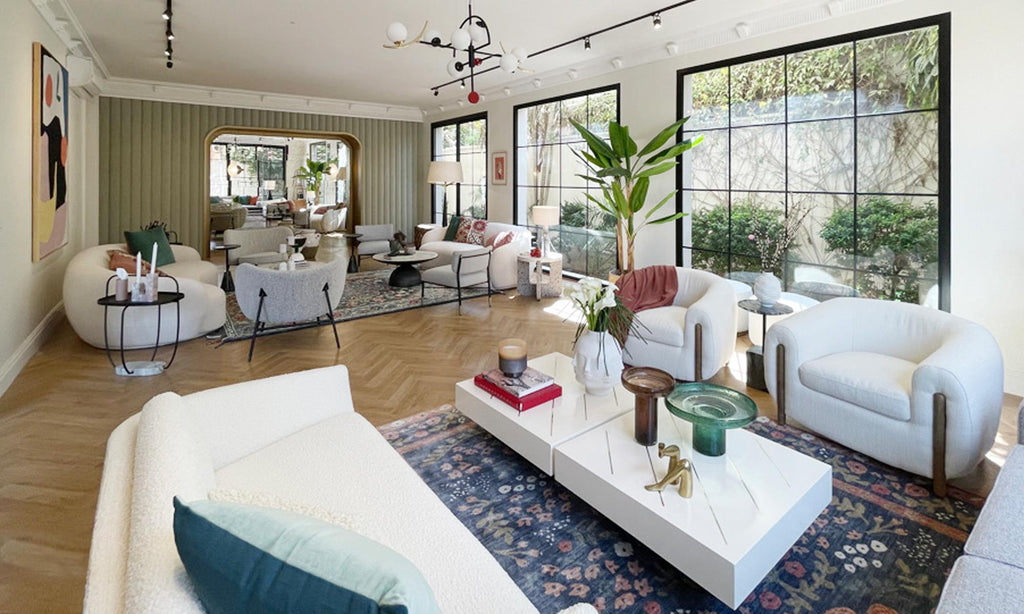
Sectional Sofa Buying Guide | Size, L-Shape & Fabric Tips

Quick answer — best fabric for a sectional sofa in Saudi Arabia: for daily family use, a tightly woven performance fabric (polyester or microfiber) or linen-cotton blend in a warm mid-tone — greige, sand, taupe or olive — handles dust and wear best and wipes clean easily. For a formal, lighter-use room, choose velvet or bouclé for the luxury look. Every fabric is compared in our Sofa Fabric & Upholstery Guide.
A sectional sofa is the largest, most-used and most regretted furniture purchase in most homes - not because people choose badly, but because they choose by photograph instead of by measurement. A sectional that is 20 cm too deep closes a walkway. A chaise on the wrong side blocks the balcony door. A beautiful light fabric in family room with children and Arabic coffee becomes a weekly cleaning problem.
This sectional sofa buying guide fixes that. It covers the decisions that actually determine whether a corner sofa works in your home: L-shape or U-shape, left or right configuration, the exact measurements to take, the size your room can honestly carry, and which fabrics survive real life in Saudi Arabia. If you are still deciding between a sectional and a regular sofa set, start with our general guide on choosing a living room sofa, then come back here for the sectional-specific decisions.
Step 1: Choose the shape - L, U or chaise sectional
L-shaped sectional. One long run with a return on one side. This is the most versatile sectional sofa for Saudi apartments and medium living rooms: it defines a corner, seats four to six, and leaves the room open on two sides. Choose an L-shape if your room is rectangular and the TV or focal point sits on one short wall.
Chaise sectional. A sofa with one extended seat for stretching your legs. It gives most of the comfort of an L-shape with a smaller footprint and a lighter look. Ideal for apartments in Jeddah and Riyadh where a full corner return would crowd the room.
U-shaped sectional. Seating on three sides. This is the villa and majlis-style option — it seats seven or more, faces everyone inward for conversation, and needs a genuinely large room. Do not force a U-shape into a medium room; it will consume every walkway and make the space feel smaller, not grander.
Modular sectional. Separate pieces that connect and can be rearranged. Choose modular if you move homes often, if access is difficult (pieces arrive one by one), or if you want to start with an L today and extend later. Check that the connectors are supplied and that every module is finished on all sides, so rearranged pieces do not expose an unfinished edge.
Browse the current shapes in RIS Home’s sofas collection - ranges like the Akon sectional come in large, medium and smaller configurations, which is exactly how you should think about it: pick the configuration for your room, not the biggest one in the showroom.
Step 2: Left-facing or right-facing? Get this right before you order
This is the single most common sectional mistake, and it cannot be fixed after delivery on a fixedconfiguration sofa.
Stand in your room facing the sofa’s position — looking at the wall it will sit against. If the chaise or return extends to your left, that is a left-facing sectional. If it extends to your right, it is rightfacing.
Now check three things against that orientation:
-
Doors and openings — the return must not block a doorway, balcony door or the main entry
path into the room. -
Windows and curtains — a high back against a low window can look awkward and block
light and curtain movement. -
The view line — the open side of the L should face the room’s entrance, so the room reads
open when you walk in, not walled off by the back of a sofa.
Product pages do not all describe orientation the same way, so if the configuration is not perfectly
clear from the photos, contact the store and describe your room before ordering. At RIS, that twominute check before you buy a sectional sofa is far easier than an exchange after delivery.
Step 3: Measure properly - the 7 numbers you need

Take these measurements in centimetres, and write them down before you open any product page:
1. Wall length where the long run will sit.
2. Return depth — how far the chaise or return can project into the room without closing the
walkway.
3. Walkways — keep 75–90 cm clear for main walking routes, and at least 45 cm between the
sectional and the coffee table.
4. Door width and height on the delivery route — including the narrowest door, not just the
front door.
5. Corridor and corner turns — a long fixed piece needs room to pivot; measure tight turns
and stair landings in villas.
6. Lift dimensions in apartments — door width, depth and height. A sectional that fits the
room but not the lift is a returned sectional.
7. Diagonal depth — for tight access, the sofa’s diagonal measurement decides whether it can
tilt through a doorway. Ask the store for this if access is narrow.
Then apply the proportion rule: the sectional’s long run should occupy roughly two-thirds to three-quarters of the wall behind it. A sectional that fills the wall edge-to-edge looks built-in and heavy; one that floats with clear space at both ends looks designed.
Step 4: Size the sectional to the room
Small apartment living room (roughly 4×5 m). A chaise sectional or a compact L around 220–
260 cm on the long run. Pair it with a round or compact coffee table and one accent chair rather
than a second sofa.
Medium family living room (roughly 5×6 m). An L-shaped sectional around 280–320 cm, seating five to six. This is the sweet spot for most Saudi family homes: generous daily seating, room for guests, and space left for a proper rug and side tables.
Large villa or majlis-style room (6×7 m and above). A large L or a U-shaped sectional, 340 cm and beyond. Anchor it with a rug large enough for all front legs, a substantial stone coffee table, and layered lighting so the scale of the seating is matched by the scale of everything around it.
In every size, plan seating honestly: allow 60–70 cm of width per person. A “6-seater” claim
means little — the centimetres are the truth.
Step 5: Frame, cushions and comfort - what to ask about
You cannot judge comfort from a photo, but you can ask the right questions:
-
Frame: look for a solid, well-joined frame described clearly on the product page. The frame
decides whether the sectional still feels firm in five years. -
Seat cushions: high-resilience foam holds its shape for daily family use; softer feather-blend
cushions feel more luxurious to sink into but need regular plumping and suit lower-use,
formal rooms. Many luxury sectionals combine both - foam core, soft wrap. -
Seat depth: deeper seats (around 60 cm and above) suit lounging and taller family members;
shallower seats are more upright and better for formal seating and older guests. Measure
your current favourite chair and compare. -
Back height: low backs look modern and keep sightlines open in open-plan Saudi homes;
higher backs give better head support for long evenings of television and conversation.
Step 6: Fabric and colour for real Saudi life

For family rooms: tightly woven fabrics in mid-tones - greige, warm beige, sand, taupe, olive. They forgive dust, which is a daily reality in Saudi Arabia, and small marks between cleans. Removable, washable covers are a genuine advantage if the model offers them.
For a luxury statement: bouclé and textured weaves give a sectional its designer look and are a signature of current modern furniture in Saudi homes. Place a bouclé sectional where use is lighter, or choose it in a warm mid-tone rather than pure white if the room is used daily.
For formal rooms and majlis use: deeper colours - emerald, burgundy, navy, charcoal - carry formality and pair naturally with marble and brass. If your sectional will serve a majlis-style layout, our Majlis Furniture Guide covers how to arrange it for guests.
Colour rule: choose the sectional colour from the room’s fixed elements - floor, curtains, wall - not from a trend photo. Floors and curtains change rarely; cushions and throws can carry the trend colour for a fraction of the cost.
Step 7: Style the sectional so it looks finished
A sectional alone is only half a living room. Complete it in this order:
1. Rug first after the sofa — large enough that the sectional’s front legs and the chaise sit on it.
2. Coffee table at two-thirds scale — roughly two-thirds the length of the sectional’s main run; marble or travertine balances the softness of a large fabric sofa and handles family use.
3. One side table and one lamp at the open end of the L, so the far seat is as usable as the seats near the wall.
4. Cushions in two colours and one texture — not five patterns. Repeat the room’s accent colour once in the cushions and once elsewhere, and stop.
The furniture collection is organised so you can build this whole arrangement from one palette —
that consistency is what makes a sectional look like the centre of a designed room rather than the
biggest object in it.
Frequently asked questions
What size sectional sofa do I need for a 5×6 m living room?
An L-shaped sectional with a long run of about 280–320 cm usually fits a 5×6 m room well, seating five to six people while keeping 75–90 cm walkways. Leave at least 45 cm between the sectional and the coffee table, and confirm the return does not block doors or the balcony.
How do I know if I need a left or right-facing sectional?
Stand facing the wall where the sofa will sit. If the chaise extends to your left, you need a left-facing sectional; to your right, rightfacing. Then check that the return does not block a door or window, and that the open side of the L faces the room’s entrance.
Is an L-shaped or U-shaped sofa better?
An L-shaped sofa is better for most apartments and medium living rooms - it seats four to six and keeps the room open. A U-shaped sectional is better only in large villa rooms and majlis-style layouts, where it seats seven or more around three sides. In a medium room, a U-shape usually feels crowded rather than luxurious.
What is the best fabric for a sectional sofa in Saudi Arabia?
For daily family use, a tightly woven fabric in a warm mid-tone — greige, sand, taupe or olive — handles dust and wear best. Bouclé and textured fabrics are the luxury choice and work beautifully in lighter-use rooms. Whatever the fabric, ask about cleaning and whether covers are removable before you buy. For the full comparison of velvet, bouclé, chenille, linen and performance fabrics, see our Sofa Fabric & Upholstery Guide.
Will a sectional sofa fit through my door?
Measure the narrowest door, corridor turns and lift before ordering, and compare them with the sectional’s dimensions - including its diagonal depth for tilting through doorways. Modular sectionals are the safest choice for difficult access, because each piece is delivered separately. If access is tight, tell the store before ordering, not on delivery day.
How much space do you need around a sectional sofa?
Keep 75–90 cm walkways around the sectional so people can pass comfortably, and about 45 cm between the sectional and the coffee table — close enough to reach a cup, far enough for legs. The return of the L should never block a door swing, a balcony door or the path to the majlis or kitchen.
What coffee table size suits a sectional sofa?
A coffee table about two-thirds the length of the sectional's main run looks balanced and serves every seat. For a 300 cm run, that means a table of roughly 180–200 cm, or a pair of smaller tables that can separate when guests arrive. Keep the 45 cm gap on all sides, and choose a stone or marble top where coffee is served daily.
Can a sectional sofa work in a majlis?
Yes — a U-shaped sectional is the modern majlis arrangement: it faces guests toward each other on three sides and seats seven or more. In a dedicated guest majlis keep the TV off the main wall and the centre open for serving. For a room that doubles as family space, an L-shaped sectional plus two armchairs gives the same welcome with more flexibility.
How do I arrange a sectional in an open-plan living room?
Float the sectional on a large rug to anchor the seating zone, with its back toward the dining zone — a console table behind the back finishes the line and holds lamps. Keep the open side of the L facing the entrance so the room reads as welcoming, and leave the main walkway from the door to the balcony or kitchen completely clear.
What seat depth is comfortable on a sectional?
Most comfortable sectionals have an overall depth of about 95–105 cm, with a chaise of 140–160 cm for full leg stretch. Very deep seats suit lounging but make upright sitting hard for shorter guests — cushions behind the back solve that. Sit on the model before buying if you can: depth is a comfort decision numbers alone cannot make.
How do I clean and maintain a sectional sofa?
Vacuum weekly with a soft brush — Saudi dust settles deep into seams — rotate and plump cushions so wear stays even, and blot spills immediately without rubbing. Removable covers can be washed or dry-cleaned per the label. Our sofa fabric guide gives the care rules for velvet, bouclé, chenille, linen and performance fabrics.
Is a sectional or two separate sofas better?
A sectional seats more people per metre, gives you a chaise for lounging, and composes the room in one decision — best for family rooms and majlis-style layouts. Two separate sofas are more flexible: they rearrange for gatherings and pass through difficult doors more easily. Choose the sectional when the layout is settled, separate sofas when the room must change roles often.
How long should a good sectional sofa last?
A well-built sectional — solid or kiln-dried hardwood frame, high-resilience foam, and a tightly woven fabric — serves 7–10 years of daily family use, and far longer in a lighter-use room. The fabric usually tires before the frame does, which is why rub count and removable covers matter at purchase. Pieces bought by measurement and material, not by photograph, are the ones still in the room a decade later.
Where can I buy a sectional sofa in Saudi Arabia?
RIS carries sectionals sized for Saudi rooms, including the Akon Large Sectional Sofa and the Akon Medium Sectional Sofa, online at ris.co with delivery across the Kingdom, and the largest models can be tested in the Jeddah showroom. Measure your room, doors and lift first, and confirm the orientation — left or right-facing — on the product page before ordering.
Choose by measurement, keep it for years
A sectional sofa bought by measurement gets used every day for years; one bought by photograph gets negotiated with every day. Take the seven measurements, settle the orientation, choose a fabric for your real life — then pick the most beautiful sectional that fits those facts. Start with RIS Home’s sectional and sofa collection and the best sellers other Saudi homes chose first, and if you are in Jeddah, sit on the largest models in the showroom before you decide.
