



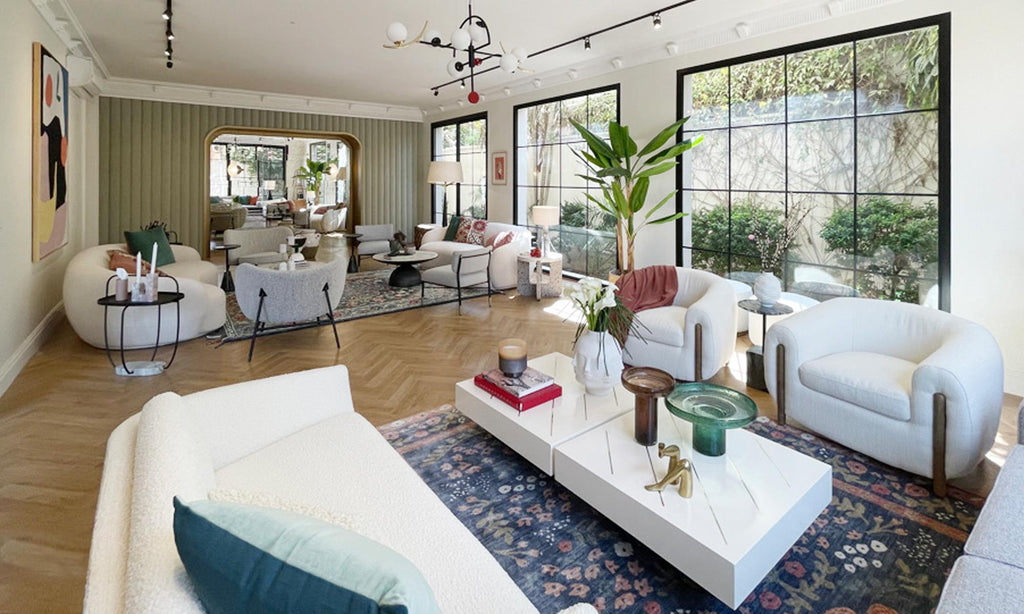
Coffee Table Buying Guide for Saudi Homes | Size, Height, Shape & Material
The Small Table That Decides Whether the Living Room Works
The coffee table is the most used and most underestimated piece in a living room. It holds Arabic coffee, dates, books, remote controls and a guest's cup - sometimes all at once and it sits in the middle of every conversation. A coffee table that is too high, too large or too sharp-edged makes the whole seating arrangement feel wrong, even when the sofa is perfect
This guide gives you the measurements that matter: height against your sofa, length against your sofa, distance from the sofa, and shape for your room - plus which materials survive daily Saudi life. For the sofa itself, see our guides on choosing a living room sofa and on sectional sofas.
Step 1: Get the height right first
Coffee table height is decided by your sofa, not by the table you like in a photograph.
- Ideal height: level with your sofa seat cushions, or up to 2–3 cm lower. For most sofas this means a coffee table height of about 40–45 cm.
- Too high and the table dominates the seating, blocks sightlines and makes it awkward to reach across it.
- Too low and guests have to bend to set down a cup, which is uncomfortable over a long visit and risky for hot coffee.
-
If your sofa has low, modern cushions, choose a lower table to match. If your sofa is deep and high-backed, a slightly taller table keeps the proportions right.
Measure your sofa seat height before you browse. It takes thirty seconds and prevents the most common coffee table mistake.
Step 2: Size the length and width to the sofa
Use the two-thirds rule: your coffee table should be roughly two-thirds the length of your sofa's main seating run. A 240 cm sofa pairs well with a coffee table of about 150–160 cm; a 180 cm sofa pairs well with a table of about 110–120 cm.
- Too long and the table crowds the walkway and makes the room feel full.
- Too short and the far seats have nowhere to set a cup, so guests balance cups on their knees or on the sofa arm.
- Width: allow 45–60 cm of depth for a rectangular table in most living rooms. Deeper tables suit large villa rooms; shallower tables suit apartments where walkways are tight.
-
Distance from the sofa: leave 40–45 cm between the sofa and the coffee table. Closer and knees hit the table; farther and reaching for a cup becomes a stretch.
For a sectional sofa, size the table to the main run, not to the whole L, and keep the chaise end clear for a side table instead.
Step 3: Choose the shape for your room
Rectangular is the most practical shape for most Saudi living rooms: it matches a standard sofa, gives the most usable surface, and works with a rug. Square suits square rooms, large sectionals and rooms where seating faces each other on two sides. Round suits small rooms, rooms with children, and rooms where people walk around the table often - there are no corners to bump into, and a round table softens a room full of straight lines. Oval gives the capacity of a rectangle with the softer movement of a round table, and suits long rooms where a rectangle would feel sharp.
In a majlis-style layout, where seating faces each other, a rectangular or oval table centred between the seats works best. In a family room with a sectional, a round table often works better, because it leaves more room to move around the chaise.
Step 4: Choose the material for real Saudi life
Marble and travertine. The luxury standard in Saudi homes, and the practical one too: stone handles hot cups, heavy trays and daily wiping, and it anchors a soft fabric sofa beautifully. Marble needs sealing and prompt cleaning of coffee spills; travertine needs the same care and a filled, sealed finish. Choose stone if you want a table that looks formal and lasts.
Wood. Warm, forgiving and easy to live with. Solid wood and wood veneer suit relaxed, family-led rooms and pair naturally with fabric sofas. Wood shows rings from hot cups if it is unprotected, so use coasters and placemats, and wipe spills promptly.
Glass. Lightens a small room and makes a space feel larger, but shows every fingerprint and dust mark - a daily reality in Saudi homes - and needs frequent cleaning to look good. Glass suits a formal, lower-use room better than a busy family room.
Metal and brass details. A brass or black steel base lightens a heavy stone top and ties the table to other metals in the room - lamp bases, mirror frames, chair legs. Check that the base does not sit where feet need to go, and that the table is stable when someone leans on it.
Browse coffee tables and side tables together in the RIS collections, so the top material, base metal and scale are decided as one arrangement.
Step 5: Style it so it stays usable
A coffee table should look styled and still work. Keep this balance:
-
A tray for cups, dates and small items. A tray contains clutter, protects the top, and can be lifted away when the table needs to serve a meal or a large gathering.
-
One low centrepiece - a stone vessel, a candle grouping or a small stack of books - kept below eye level across the sofa, so conversation is not blocked.
-
One empty third. Leave about a third of the table surface clear at all times. A table that is fully decorated has nowhere for a guest to set a cup, which defeats its purpose.
- A side table at the far end of the sofa, so the farthest seat is as usable as the seats near the centre.
If the table is used for family meals, homework or work, choose a larger, sturdier top and skip delicate décor. The table should serve the life of the room, not just photograph well.
5 coffee table mistakes to avoid
-
Wrong height - a table chosen by looks that sits far above or below the sofa seat.
-
Too big for the rug - a coffee table should sit fully on the rug, with the rug extending beyond it. A table half on and half off a rug wobbles and looks wrong.
-
Sharp corners in a busy family room - round or oval tables are kinder where children run and guests move around the table.
-
No tray, no protection - hot cups directly on wood or unsealed stone will mark the top over time.
-
Filling every centimetre - a styled table with no space for a cup is a display shelf, not a coffee table.
Frequently asked questions
What size coffee table do I need for my sofa?
Choose a coffee table about two-thirds the length of your sofa's main seating run. For a 240 cm sofa, that is about 150–160 cm; for a 180 cm sofa, about 110–120 cm. Leave 40–45 cm between the sofa and the table, and make sure the table sits fully on the rug.
How high should a coffee table be?
A coffee table should be level with your sofa seat cushions, or up to 2–3 cm lower - usually about 40–45 cm high. Measure your sofa seat height before buying. A table much higher than the seat blocks sightlines; a table much lower makes it awkward to set down a cup.
How far should a coffee table be from the sofa?
Leave 40–45 cm between the sofa and the coffee table. This gives enough room for knees and for walking past, while keeping cups within easy reach. In a small apartment, 40 cm is the minimum; in a large villa room, 45 cm still feels comfortable.
Is a round or rectangular coffee table better?
A rectangular table suits most standard sofas and gives the most usable surface. A round table suits small rooms, rooms with children, and rooms where people walk around the table often, because it has no corners to bump into. A square table suits square rooms and sectional layouts where seating faces each other.
What is the best coffee table material for Saudi homes?
Marble and travertine are the most popular luxury choices in Saudi homes: they handle hot cups and daily wiping, and they anchor a fabric sofa. Wood is warmer and more forgiving for family rooms. Glass lightens a small room but shows dust and fingerprints most, so it needs frequent cleaning in Saudi homes.
How do I protect a marble coffee table from coffee stains?
Seal the top when it is new and re-seal every 6–12 months, wipe coffee spills immediately with a soft cloth and a pH-neutral cleaner, and use a tray, coasters and placemats. Never clean marble with vinegar, lemon-based cleaners, bleach or abrasive pads.
Should a coffee table sit on the rug?
Yes. The coffee table should sit fully on the rug, with the rug extending beyond the table on all sides. The rug should also sit under the front legs of the sofa. A table that is half on and half off a rug will wobble and looks unfinished.
What size coffee table works with a sectional sofa?
Size the table to the sectional's main run, using the two-thirds rule, not to the whole L-shape. A round table often works well with a sectional, because it leaves more room to move around the chaise. Keep the chaise end clear for a side table, rather than extending the coffee table to cover it.
Do I need a coffee table and side tables?
In most living rooms, yes. The coffee table serves the centre seats; side tables serve the end seats, where a guest would otherwise have nowhere to set a cup. One side table and one lamp at the open end of a sofa or sectional makes the far seat as usable as the seats near the centre.
Where can I buy a coffee table in Saudi Arabia?
You can browse coffee tables, side tables, sofas and home décor in the RIS collections at ris.co, and in the RIS showrooms in Jeddah. Check the best sellers for the tables other Saudi homes chose most, and confirm the exact height, length and top material on the product page before ordering.
The table in the middle of everything
A good coffee table is measured, not guessed: the right height against your sofa, two-thirds of its length, 40–45 cm away, on a rug that is big enough, in a material that suits how you actually live. Get those numbers right, and the whole living room feels considered. Start with the RIS coffee tables collection and the best sellers other Saudi homes chose first.
